
What Is NetSuite? Oracle NetSuite ERP Explained
NetSuite is the #1 cloud Enterprise Resource Planning (ERP) system on the market.
About NetSuite Cloud ERP

A Comprehensive, Modular ERP Solution
The Leading Customizable Cloud ERP Solution for Enhanced Business Efficiency

NetSuite for the Controller

NetSuite for the CFO

NetSuite for the CIO

NetSuite for the Sales Manager
NetSuite for the Operations Manager

NetSuite for the Support Rep
NetSuite Features and Capabilities
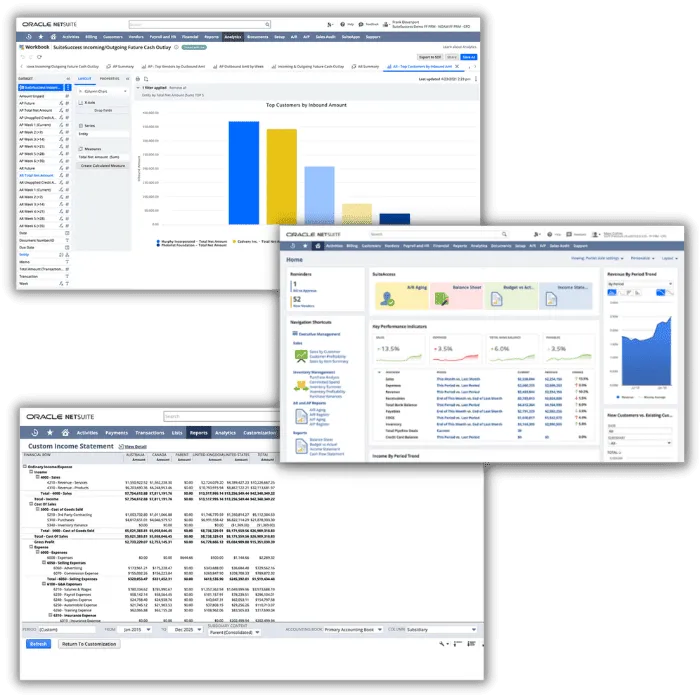
NetSuite ERP Features:
Financial Management
- Advanced Financials
- Billing Management
- Revenue Management
- AR/AP Automation
- Planning & Budgeting
- Streamlined Reconciliation
- Global Financials
- Subsidiary Consolidation
- Fixed Asset Management
Customer Relationship Management (CRM)
- Marketing Automation
- Contract Renewal Automation
- Incentive Compensation Management
- Configure, Price & Quote
- Sales Analytics & Reporting
- Pipeline Management
- Partner Management
- Sales Forecasting
- Customer Service Optimization
Business Intelligence
- Advanced Analytics
- Data Consolidation
- Self-Service Reporting
- Embedded AI
- Drill-Down Capabilities
- Export Friendly
Inventory Management
- Multi-Location Inventory Management
- Demand-Based Inventory Replenishment
- Lot & Bin Management
- Serialized Inventory
- Efficient Counting
- Advanced Order Management
- Grid Order Management
Global Management
- Multi-Currency
- Multi-Language
- Global Accounting & Consolidation
- Indirect Tax Management
- Subsidiary Management
Professional Services Automation (PSA)
- Project Management
- Job Costing
- Resource Allocation
- Project Billing
- Project Reporting
Supply Chain Management
- Simplified Procurement
- Pack & Ship Management
- Demand Planning
- Quality Management
- WIP & Routings
- Work Orders & Assemblies
- Advanced Manufacturing
Warehouse Management System (WMS)
- Barcode Scanning
- Mobile Functionality
- Warehouse Activity Dashboards
- Warehouse Team Management
- Intelligent Picking
- Simplified Return Management
- EDI / 3PL Integration
Why Businesses Love NetSuite Software
Unified Business View
Integrations
True Cloud
Deep Reporting Capabilities
Built-in Flexibility
NetSuite FAQs
What is an ERP?
ERP is the acronym for Enterprise Resource Planning, a software system that unifies and automates core business operations and processes, including HR, finance, financial planning & analysis, and operations. ERPs offer a single solution to manage most, if not all, business departments and processes.
What Makes ERP Unique Over Using Multiple Software Applications?
If you use multiple software applications to run your business, you may be missing out on opportunities to streamline your operations. An Enterprise Resource Planning (ERP) system allows you to manage large volumes of data in a centralized solution, making analysis and insight easier and more efficient. With an ERP system, you achieve full integration and real-time communication across all departments, avoiding information gaps and saving time on manual data consolidation.
How Do I Know I Need an ERP System?
You are using multiple software systems or applications. You cannot easily access financial information about your business. You have too many manual and time-consuming processes. You are struggling to meet customers’ ever-changing demands. Your IT processes are extremely complicated. Your business is scaling quickly, and your current systems can’t keep up. You spend too much money on IT support services. You are looking at a future liquidity event such as a capital raise, acquisition, or IPO.
What Are the Most Important Things to Look for When Choosing an ERP?
Scalability and Flexibility: An ERP system should be flexible enough to scale with a business’s needs. Avoid legacy on-premise systems that are really just a patch-and-run job; the company will quickly outgrow these lesser options. Seek an ERP with the agility to integrate with emerging technologies and adapt with your business and its environment; this will ensure that your business is future-proof. NetSuite is often considered the last ERP you’ll ever need, and will scale with your business from startup to IPO and beyond. Mobile-Friendly: Employees should be able to access ERP dashboards in order to get the information they need when they need it. They should also be able to enter data directly from the field, which reduces the risk of errors that occur when they have to re-enter data collected at a previous time. NetSuite offers mobile and tablet capabilities, which along with its cloud architecture, means it can be accessed anytime from anywhere in the world. Analytics: Business intelligence is key to strategic success. An ERP system with built-in analytics capabilities can help you track KPIs and make more strategic and timely decisions. Plus, data will need to be accurate and available in real-time. NetSuite allows you to quickly consolidate cross-departmental data, updated in real-time, for improved visibility and analysis making it a key favorite amongst even the most data-focused customers. Modularity: Top ERP systems like NetSuite are built from modules that can be connected together to form a seamless whole. Each module’s functionality has been designed to dovetail well with the others, so as your business grows, you can continue to add on modules and expand your capabilities. These modules cover industry-specific functionalities such as Professional Service Automation, as well as department/role-specific functions such as Supply Chain Management or HR.
What is NetSuite ERP?
NetSuite ERP is an all-in-one cloud business management solution that helps organizations operate more effectively. NetSuite’s multi-tenant platform provides real-time visibility into operational and financial performance across your entire business—and scales to meet the needs of companies of any size. It serves as one single system to provide you with finance and accounting, inventory management, CRM, marketing automation, human resources, and more.
What NetSuite Modules Are Available?
NetSuite has an entire suite of modules that can be tacked onto its base ERP offering to expand the functionality and fit your organization’s needs. These modules include: Finance, Procurement, Manufacturing, Inventory Management, Order Management, Warehouse Management, Supply Chain Management, Customer Relationship Management (CRM), Professional Services Automation (Service Resource Management), Workforce Management, Human Resources Management, Ecommerce, and Marketing Automation.
What Industries Use NetSuite?
NetSuite can be adopted by practically any industry thanks to its high level of customization, including robust omnichannel support. Common industries that thrive on NetSuite include (but are not limited to) Wholesale Distribution, Software, Life Sciences, Professional Services, Field Services, Manufacturing, Energy & Utilities, Private Equity, Food & Beverage, and more.
How Long Does It Take to Implement NetSuite?
On average, it takes a few months to fully implement NetSuite. ERP implementations are large projects, but skilled NetSuite Consultants like ScaleNorth can make the NetSuite implementation process seamless.
What is the Cost of NetSuite?
NetSuite pricing is based on a subscription model. Pricing varies depending upon modules needed, number of users, length of license term, and number of entities and locations. When working with ScaleNorth, we’ll draw on our deep NetSuite experience and business acumen to help you find the ideal package and price point for your business.
How Do I Know If NetSuite is Right for Me?
NetSuite is trusted by 43,000+ organizations worldwide, ranging from small businesses to large enterprises. Roughly 20% of Fortune 100 companies utilize NetSuite, and it’s considered one of the most robust and customizable ERP solutions.
What is the Ideal Size of Business to Use NetSuite?
NetSuite works for businesses from start-ups to large companies. You can scale your business without incurring additional hardware costs, since your business is in the cloud. Unlike QuickBooks or other limited systems, NetSuite supports businesses of any size, with global consolidation, advanced automation, and SuiteApps that extend core functionality.
Can I Import Data Into NetSuite?
Yes, importing data to NetSuite is easy. NetSuite users can import data in a variety of ways, from comma-separated values (CSV) files to integrations via application programming interfaces (APIs).
Is NetSuite Mobile Friendly?
Yes, NetSuite features a mobile solution with a specialized interface for iPhone and Android devices, giving you access anytime, anywhere.
What is a NetSuite Solutions Provider?
NetSuite Solution Providers like ScaleNorth are NetSuite experts who deliver complete NetSuite solutions, including implementation, support, and customizations. ScaleNorth is recognized as a certified NetSuite Solution Provider by Oracle NetSuite.
Why is NetSuite a Top ERP Choice?
NetSuite’s ERP solution helps businesses become more competitive, lower costs, streamline business processes, and increase efficiency. It was built specifically for the cloud, giving it an edge over other ERP systems that are either on-premise or adapted for the cloud. All NetSuite users are running the same version, and updates happen seamlessly and automatically.